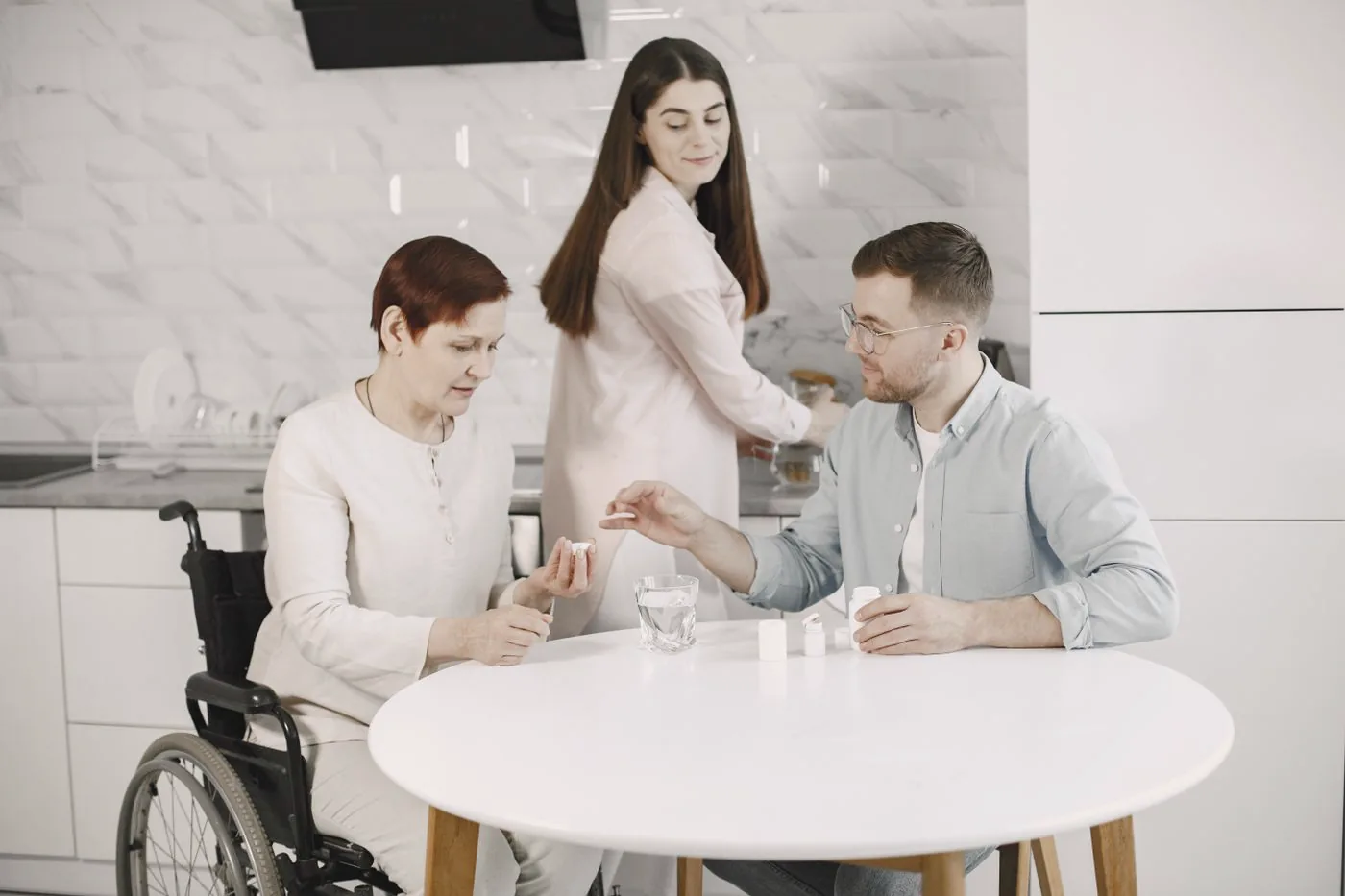
Communication changes with dementia. Argue less, connect more: short sentences, one question at a time, a calm tone, and respond to the feeling behind the words. Today: pick one repeated question and write the answer where it can be seen.
Ask a nurse or therapist to show you once General safety guidance, not a substitute for hands-on training.
01Before you start
- Reduce noise: turn off the TV, close the door, and sit at eye level.
- Check hearing aids, glasses and dentures. Pain and constipation make communication harder.
- Use the person’s name and a familiar greeting.
02Do this
Get attention first
Say their name, make eye contact, and touch their hand lightly if welcome. Wait before speaking.
Use short sentences
One idea per sentence. “Time for lunch.” Pause. “Let’s wash hands.” Avoid long explanations and multiple choices.
Ask one question
Offer two choices at most: “Tea or water?” Not “What do you want?” Give extra time to answer.
Respond to the feeling
If they say “I need to go home,” try “You miss home.” Then redirect: “Let’s have tea by the window.” Do not argue about facts.
Use written cues
Put a note by the chair: “Doctor Thursday 10am.” Label doors. Keep a whiteboard for the day’s plan.
03Do not do this
- Do not argue, quiz or correct every detail.
- Do not talk over them or finish their sentences impatiently.
- Do not use baby talk or talk about them as if they are not there.
- Do not crowd or approach from behind.
Call a nurse or doctor if
- A sudden change in speech, confusion or alertness.
- New agitation with pain, fever, constipation or a medication change.
- Aggression that puts anyone at risk.
- Hallucinations or delusions that are new or frightening.
04Printable checklist
- One repeated question identified
- A written answer placed where it can be seen
- Hearing aids and glasses checked
- A quiet place to talk
- Two-choice questions practised
- A redirect activity ready
Questions people ask
Should I remind them that someone died?
What if they become aggressive?
How do I talk to a parent who does not recognize me?
Sources
- Communication and Behavior Alzheimer’s Association · Accessed Nov 2026
- Caring for a Person with Alzheimer’s Disease National Institute on Aging · Accessed Nov 2026
- Dementia World Health Organization · Accessed Nov 2026
Was this page helpful?
Thank you. That helps us decide what to improve.
What's carrying the most weight
A short, private check of what care is taking out of you right now. It is not a diagnosis, and it will not tell you to “practice self-care.” It will show you which parts are heaviest, and give you a next step.